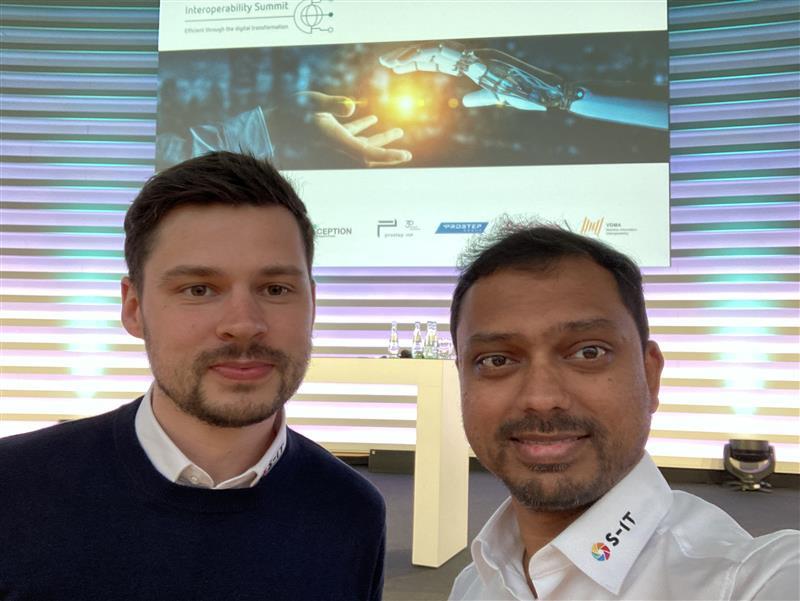
Our colleagues Deepak Sivaprakash and Nicola Wolter attended the Interoperability Summit in Bonn, where they gathered valuable insights from conversations and discussions.
One idea, in particular, stood out: Today, true interoperability often no longer fails because of missing technology or insufficient standards. The real challenge lies in creating tangible business value from interoperable systems.
This is especially important in engineering. Many companies invest in data models, interfaces, standards, and digital processes. However, the benefits of these efforts often only become visible at a much later stage. At the same time, significant upfront investment is required in areas such as structure, data quality, system integration, and process transformation.
For initiatives like these to succeed, technical compatibility alone is not enough. What matters is a well-founded strategy that defines from the outset what goals are to be achieved, which use cases are relevant, and how the resulting value can be measured.
Interoperability is therefore not an end in itself. It must help make development processes more efficient, transparent, and reliable. Only when data can be meaningfully used across systems and organizational boundaries does it provide a solid foundation for new digital ways of working.
This is particularly true for the Digital Twin. It can only deliver its full potential when the underlying information is consistent, interoperable, and available in the right context. Standards provide an essential foundation, but real value is created only through their consistent integration into real-world processes and business objectives.
The discussions at the Interoperability Summit made it clear that this is exactly where the industry needs to continue evolving: at the intersection of standardization, technical implementation, and business value.
We would like to thank the organizers and everyone involved for the open and honest exchange, as well as for the many valuable insights.